Lost In Music
Shabaka and Friends, Queen Elizabeth Hall, London: Friday June 12 2026

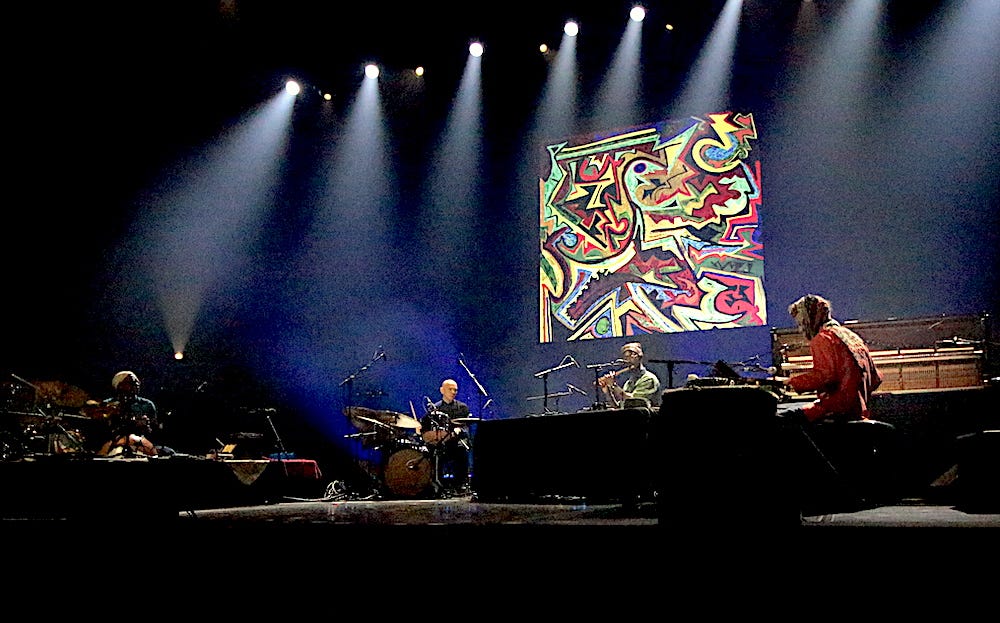
In a short, laudatory piece on his Substack encouraging readers to seek out Shabaka’s new album as one of 10 recent releases he was recommending, the revered jazz critic, historian, author and musician Ted Gioia writes of the record: “I’m not even sure if this is real jazz.” At first glance, and given who’s written it, that statement might appear to be somewhat condemnatory: but in the context of his four succinct paragraphs, it’s clear Gioia means this as a very strong positive. Had he been at the Queen Elizabeth Hall on Friday for an extraordinary performance by a line-up billed as Shabaka and Friends, one wonders whether he may have gone further. At times during the two-hour set, even the limits implied by the designation “music” did a disservice to what was happening on stage. Not in the sense of the lazily dismissive “this just isn’t music” school of (non-) thought, but because what we often think music is doesn’t go far enough to encompass the kinds of things this group were doing.
Certainly, the economic and commercial conventions of the 21st century music business - whatever they may be right now - were among the first elements junked here. Of the Earth is barely three months old, and - an April gig at Village Underground apart - this was Shabaka’s first headline show in the UK since its release. As part of the annual Meltdown festival at the Southbank, this year curated by Harry Styles (who was spending the night a few miles to the north west, in the early stages of his record-breaking run of sold-out shows at Wembley Stadium), it was certainly the highest-profile opportunity he had to promote his new LP. Rather than use an outstanding band - Sebastian Rochford, who played with Shabaka in Sons of Kemet, Dan Nicholls and Dudù Kouate - to re-play or re-create parts of the album, the players took that record’s exploratory soundbed as an inspiration and starting-point, and headed off into totally new territory. At the end of the set, Shabaka mentioned that an album of work from this group is on the way - it will be the second release from his own, new label, and will come out under Nicholls’ name.
Just as unconventional were (some of) the instruments played, the way they were used, and the blurring of lines that can be drawn, usually, around what each musician would be expected to do on stage. Here, Rochford was the outlier: his drum kit featured an extraordinarily shaped gong but included only percussion instruments. The other three all blurred the boundaries that would even permit describing their role in the usual traditional way (”percussion”; “keyboards”; “reeds/woodwind”).
Shabaka sat behind a table festooned with various flutes, several pieces of electronic equipment, and a small box that produced ringing, bell-like tones, all of which were used at different stages of a set that, while at times suggesting that it may be made up of individual portions that constituted separate compositions, was presented as an unbroken extended piece. There were short passages on clarinet, and on a couple of occasions he played a bass clarinet, which he chose to assemble before and disassemble after use each time. The saxophone he made his name with, and returned to using after a two-year break for parts of Of the Earth (and which he played with ferocious focus, as if renewing his acquaintance with the instrument had redoubled his muse’s vigour, during an inspirational and emotional appearance with Ezra Collective a few weeks ago), was entirely absent.
Nicholls’ upright piano had its upper front panel removed, exposing the strings and hammers - and reminding you that, in a sense, it’s really a kind of percussion instrument. He also played sub-bass from a small electronic keyboard, used a flute at one point, a lute briefly at another, and triggered samples and effects from a separate control box. Kouate sat cross-legged on a large, square riser, began the set playing small bells and rattles, but soon brought out an astonishing array of different, unusual, and quite possibly unique percussion instruments - though he also played a flute. Towards the end of the set he spent several minutes producing strange, ethereal tones from an instrument that may well have been home-made - he appeared to be forcing air through two hollow tubes (maybe bamboo flutes?) by plunging the bottle-shaped cones fixed to the bottom of each into a bucket of water and manipulating the rate at which the air was released by moving his thumb over the top of each tube.
What they did, together, was to use the constituent parts of musical expression and composition - rhythm, melody, timbre, tone - and combine them with things altogether more elemental: breath, time, care, love. The process transformed the raw ingredients from artistic qualities into structural materials, out of which these four master magician-musicians built a new world. From time to time, the different parts converged into sections that obeyed many of the rules that usually govern musical composition, allowing phrases to be isolated and interrogated, and turned into tunes/songs. And each of these were conjured out from, and allowed to settle back in to, a more abstract flow of sound: flutes suggesting bird song, a sample that almost certainly was, a bow dragged along the edge of a bell, piano notes like footsteps or rainfall. It’s evidently a source of some debate as to who originally coined the notion that all art aspires to the condition of music: but here was music aspiring to something beyond even that. Astonishing.