Miles Ahead
Kamasi Washington, Royal Festival Hall, London; Steam Down, Southbank Centre Riverside Terrace, London; Jay Phelps Quintet, Jazz Cafe, London: Sunday/Monday June 14/15 2026

It’s an intriguing, and entirely apt, contradiction. Just when you start to think that the Miles Davis centenary is getting a bit much, with event after album release after box set drip-drop-dropping on to the calendar, you end up blown away by how the group of musicians you’ve just seen have taken the music as a starting point but have also remembered that iconoclasm and ceaseless reinvention were as pivotally important parts of the Davis brand as the trumpet and the notes that came out of it. The idea of a “tribute” gig implies nostalgia and threatens a dearth of imagination or innovation: but the musicians who really, truly do wish to honour Davis’s music know that they can’t do so without bringing something new, unexpected and unapologetically individual to the table.
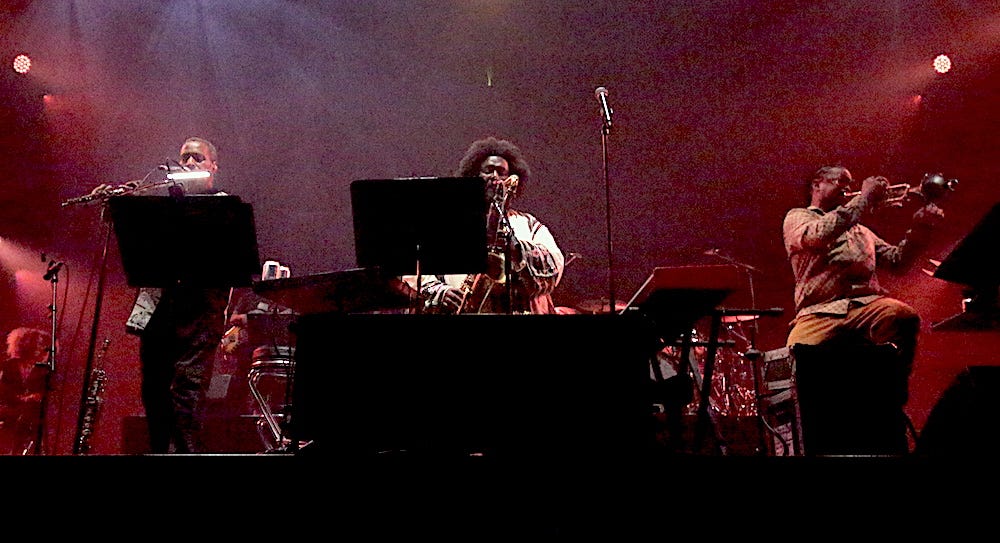
Kamasi Washington’s tribute - the first of two sold-out shows on the same day at the Royal Festival Hall as part of the Harry Styles-curated Meltdown (a review of the second one is here) - went further. It was billed as a one-off celebration marking the centenaries of the births of both Davis and John Coltrane - but, with both Sonny Rollins and Washington’s friend and fellow West Coast Get Down member Ryan Porter having “joined the ancestors,” as Washington poetically put it, in May, the plans for the set expanded.
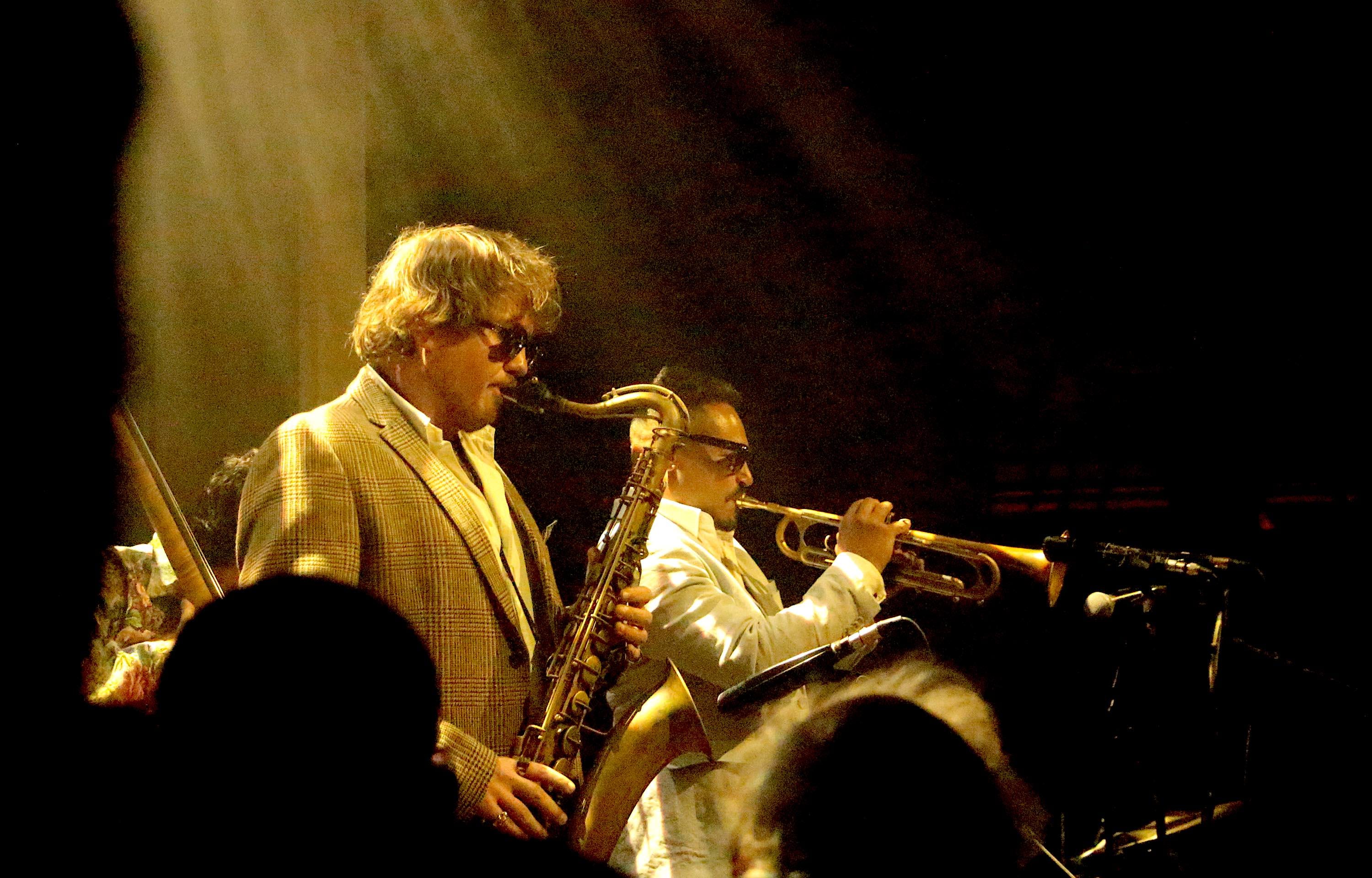
The approach Washington and his band took was simple but radical. Rather than go down either of the obvious routes - play music by each artist and give it their own spin; use the icons’ music as a stepping-off point, and make new music inspired by it - they opted for a different path. This meant a set constructed of what club DJs of the turn of the century would have described as mash-ups. Thus, the opening piece - ‘Olé All Blues’ - took the Coltrane and Davis tunes and had the band playing them together, with Washington and his father, Ricky (on tenor sax and flute respectively), taking the ‘Olé’ line while trumpeter Maurice “Mobetta” Brown, resplendent in very Miles-evoking oversized sunglasses (shades of Get Up With It, indeed), rolled through ‘All Blues’ riffs. The concept stood more starkly revealed by the title of the second piece: ‘Acknowledgement of A Love Supreme At a Little Church’. In a short introduction, Washington joked that the idea sounds a little bit crazy - but it really, really worked.
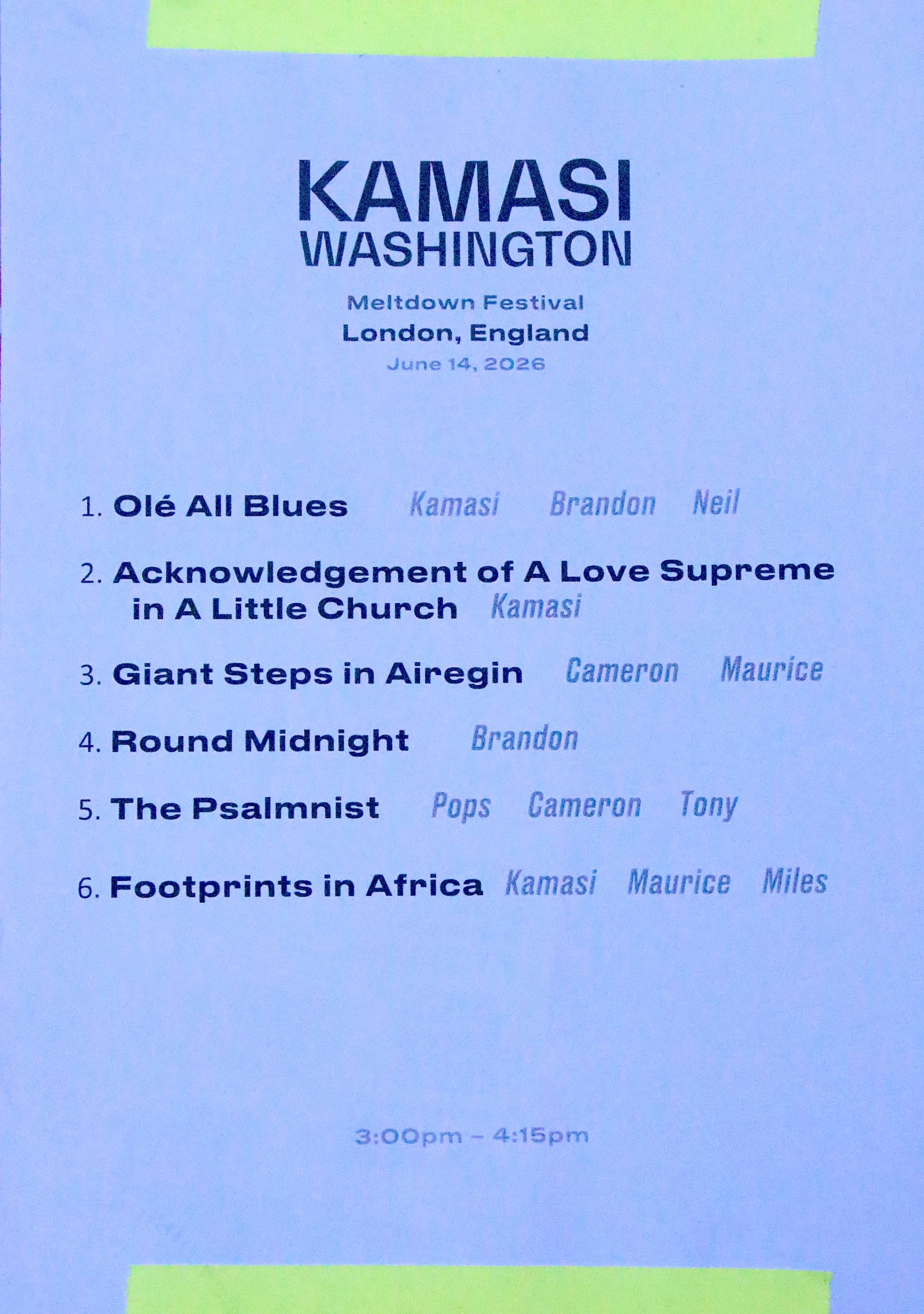
One of the best things about watching Washington and his band is the opportunity to share in the delight each instrumentalist experiences, clearly in part because of the environment their leader has helped to create for them to work within. Every member clearly loves and enjoys their fellow members’ solos, and Washington shares the time in the spotlight around. All eight members got at least one spot, and their leader himself only took three solos - into which, of course, he poured everything he had, his bar-type stool clearly necessary long before the conclusion of each, the mental and emotional efforts expended clearly exacting a physical toll, too. During his solos, inevitably (if unimaginatively) one was reminded of Ira Gitler’s coinage “sheets of sound” - a phrase I’ve never been entirely sure how to interpret. Are we intended to see hundreds of hemidemisemiquavers scattered like iron filings all over the staves on sheets of music? Is it meant to evoke sheets of rain cascading in rivulets down a window? Or are we being encouraged to conjure images of bedsheets and shirts on a washing line, snapping and furling in the wind (like the ones Mrs. Bartolozzi washed in Kate Bush’s song)? The way Kamasi Washington plays, it sometimes seems like all of that, and more, at once. His warmth, spirit and generosity imbued the entire set, and it’s clear that the whole band had made a similarly open-ended commitment to each other and to the music. This was never more apparent than during and immediately after an understandably and spine-tinglingly emotional reading of ‘The Psalmnist’, the only piece played that has appeared on a Washington album, and the only one that had not been recorded by Coltrane, Davis or Rollins: it was written by trombonist Porter and the version played in London was transcendent.
When the solos came from the rear of the stage - the line-up boasting two bassists presumably another deliberate homage to Coltrane - Washington headed off to the side of the riser, allowing the audience an uninterrupted view. His delight in everyone’s contribution was written on his face, as was his sense of surprise and approving awe with a bandmate when they delivered something he hadn’t been expecting, or which impressed or moved him. This was reciprocated whenever he soloed, too, particularly in the reactions of his father, whose facial expressions started out as if in a kind of patient, “OK then, let’s see what you’ve got this time, kiddo” kind of mood, where a slight raise of an eyebrow felt as loud as thunderous applause. By the time he smiled and nodded during his son’s final solo of the afternoon, you knew that what had just been played had reached a level that qualified as truly special.
The following night, at the Jazz Cafe, a very different Davis-themed event proceeded in a manner not entirely dissimilar, and at no less elevated a level. As he mentioned at the start of the first of two sets, Jay Phelps has been playing gigs at the same venue based around A Kind of Blue for five years. And, as he also alluded to during the evening, his central status in the current Davis-go-round was cemented last year and early this by him having conceptualised and co-starred in Miles, a play based on the conceit that a character called Jay, played by Phelps as a version of himself, might have communed and conversed with Davis’s immortal spirit while trying to investigate, via the studio master tapes, the creation of that album. The play ran at the Edinburgh festival last August and transferred to the Southwark Playhouse early in this centenary year; I saw it during that second run and to say that it worked on every level of its ambitious and demanding premise is an understatement.
So we knew, going in, that Phelps has a unique take on Davis and any celebration of his work would be singular, invulnerable to criticism that it might be founded in anything less than extensive and in-depth study of the source material, and that this performance - which promised to look at material from across the entirety of Davis’s career - would be very different to what Phelps has done with Miles’s music before. Leading his own great quintet of superb London-based players - Eddie Cicchetti (double bass), Callum Connell (on tenor sax, though apparently the first the rest of the band knew their altoist even played it was when he turned up at their one - ONE!!!! - rehearsal with it), Nicola Guida (keyboards) and Harry “Mackwood” Ling (drums) - Phelps took the audience on a Cook’s tour through the Davis catalogue. The selections were a blend of the perhaps expected and the eye-openingly singular, and were played in chronological order, kicking off with tunes Davis played on before becoming a bandleader, taking in a reading of ‘Concierto De Aranjuez’ played as it might have been had the Aghartha and Pangaea band had a crack at it in 1975, and ending with ‘Human Nature’ and ‘Time After Time’.
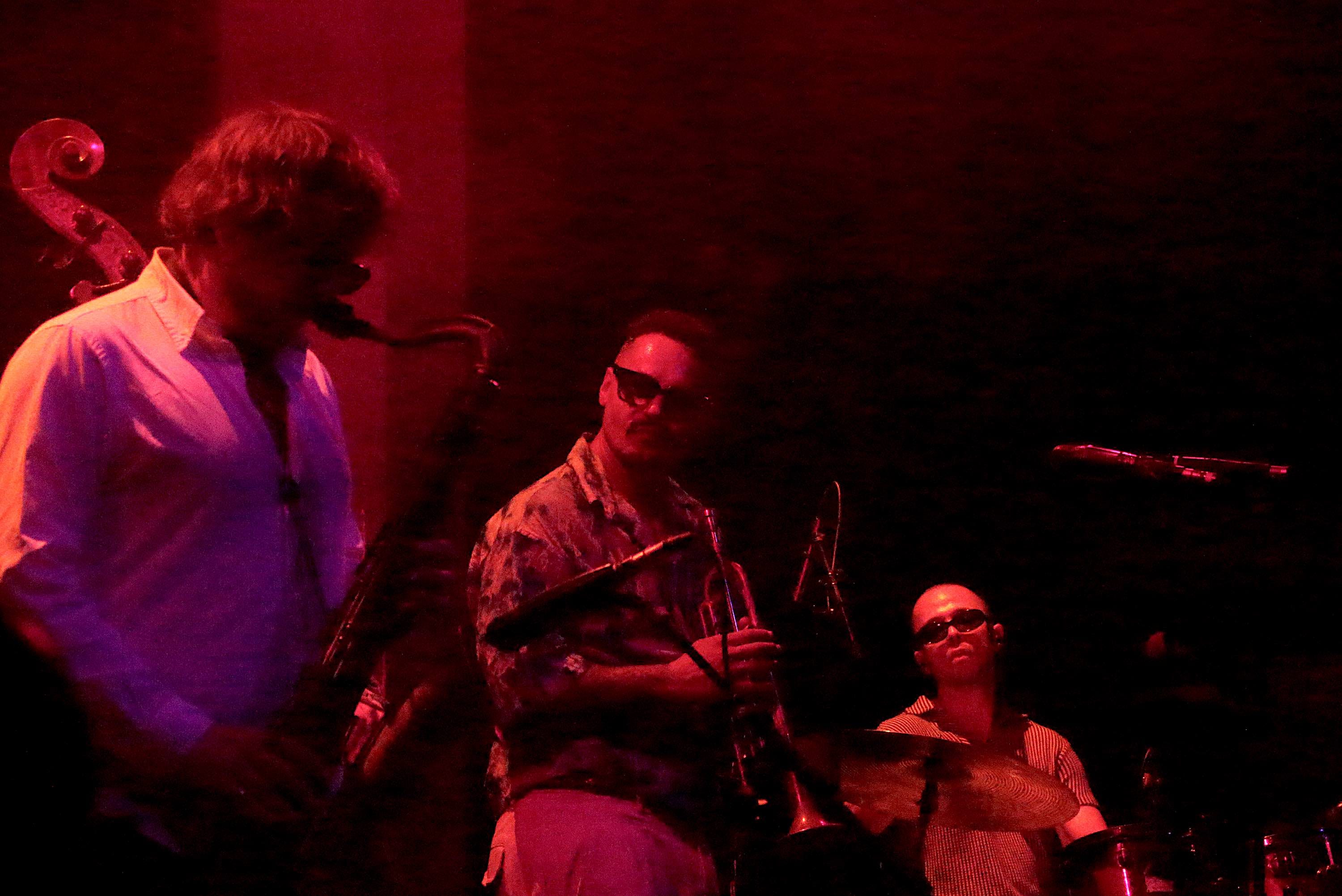
The one exception to the calendar-based sequence came in the ambitious but entirely successful encore, when this compact line-up essayed a necessarily time-constrained yet impeccably rendered version of ‘Bitches Brew’. While Phelps and Connell were able to concentrate on their own instrument’s parts, the rest of the group had to do at least triple duty, Mackwood more than capably doing both the Lenny White and Jack DeJohnette parts and Guida not just aiming in both the Chick Corea and the Joe Zawinul ranges but covering for John McLaughlin’s guitar, too. But the key to this version’s success lay in Cicchetti’s subtle overhauling of the twin bass parts, cutting the pattern in half and revising its pulse, so that you were hearing Coltrane long before Phelps began intoning “a love supreme” over the top of it. While the correlation was not a difficult one to make, the way they reached it was sublime.
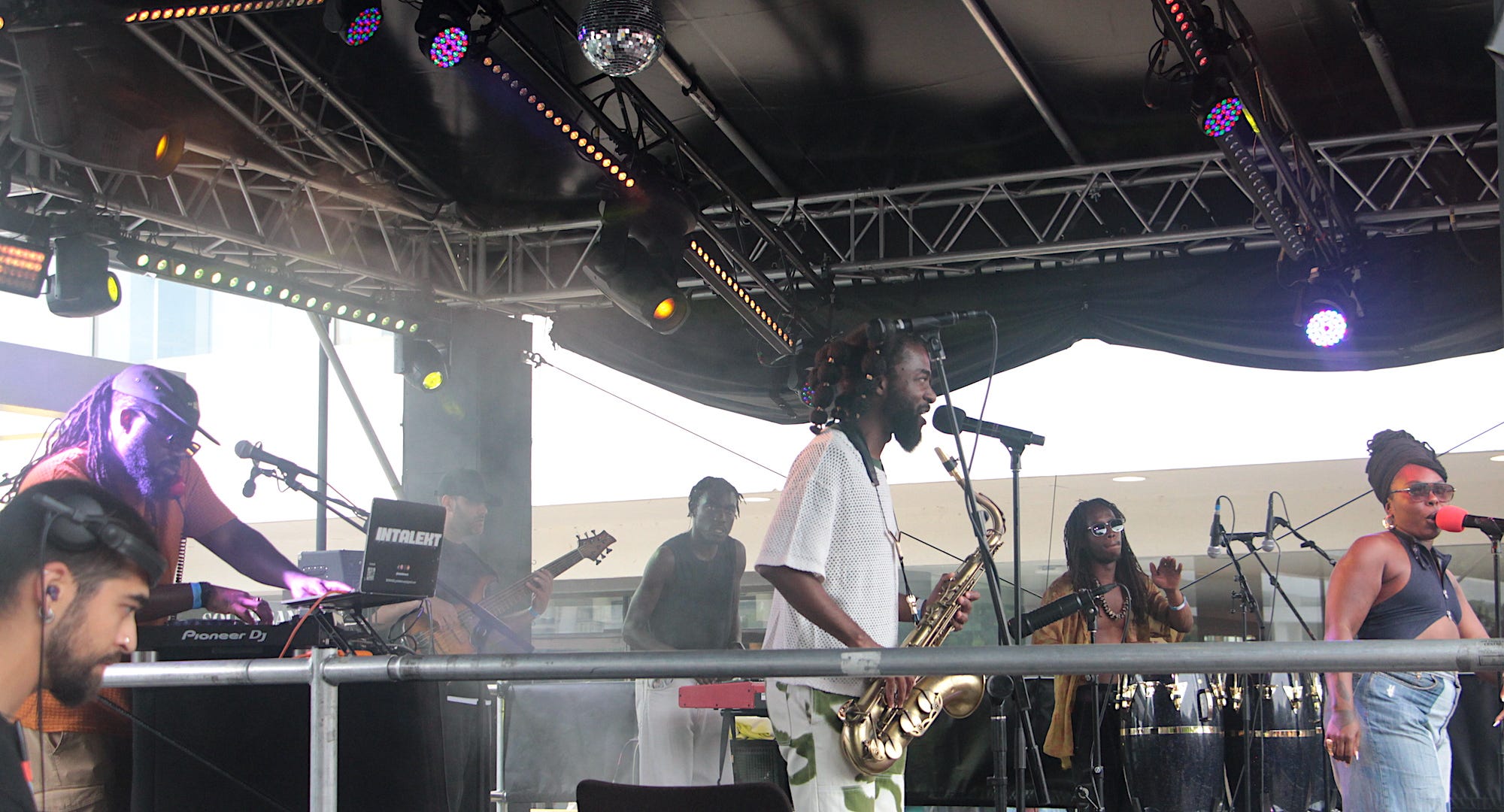
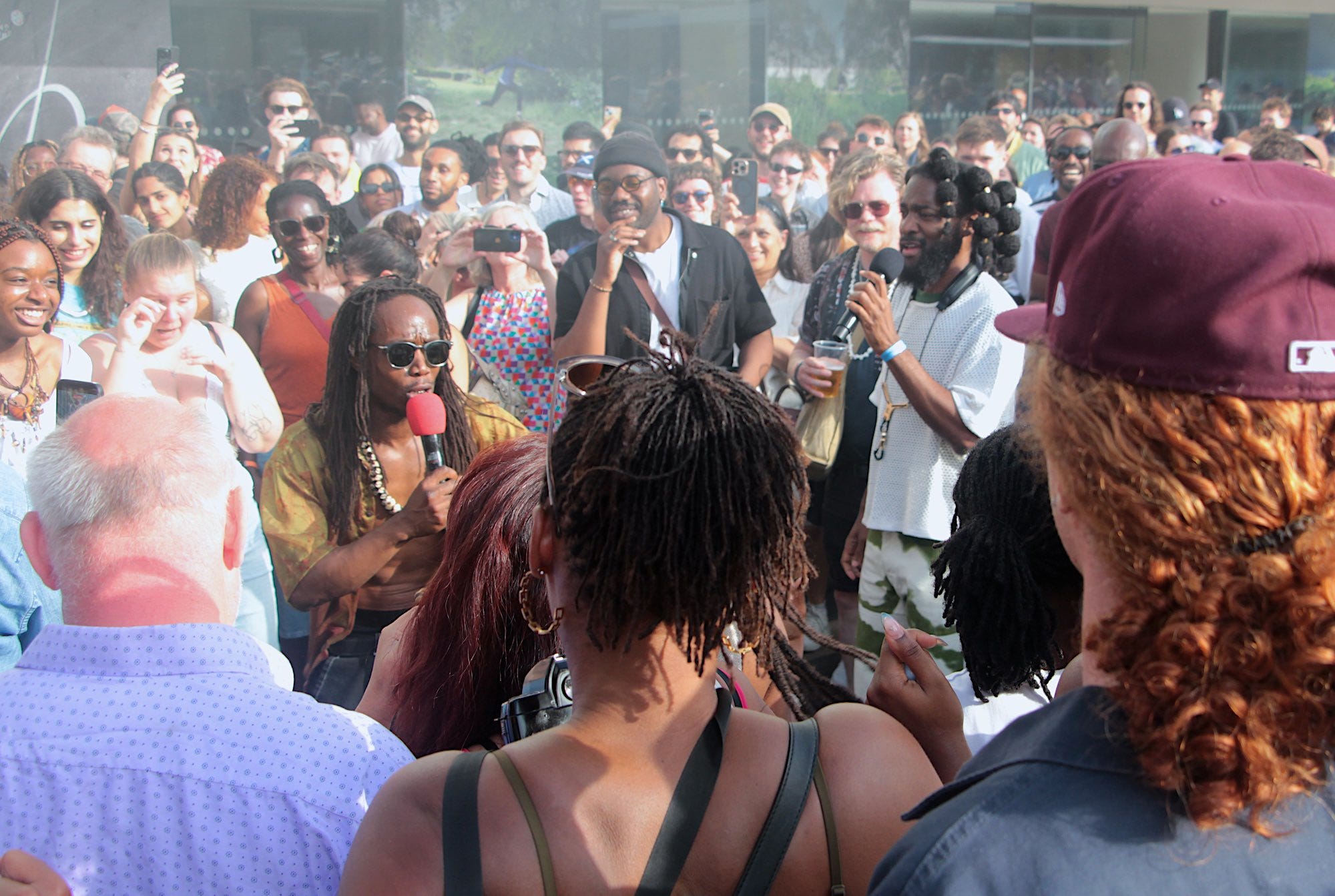
In between these two phenomenal performances - on the outdoor stage in front of the Festival Hall, under glowing summer sun and open to everyone who happened to pass by - the unstoppable force that is Steam Down got in on the act, too. Their free Meltdown takeover wasn’t part of any overt Davis or Coltrane homage, but the band/collective/movement’s very existence is an uncredited and implicit tribute to those artists’ most prized virtues. There are echoes of Coltrane in the way they meld spirituality with technical virtuosity, soul with precision; and the way they almost by default manage to use compositional structure as a gateway to unfettered freedom of expression. From Davis, you sense, they draw something of the confidence needed to - apparently fearlessly - reinvent genres and styles, to allow themselves to be inspired by sounds or approaches that cross all kinds of boundaries, and to be able to bring these sonic worlds together in a new kind of music. And in leader and lightning rod Ahnansé, they clearly have someone at the heart of the operation that understands - like Davis did - how to build a team, and how to blend talents to bring the best out of each in hitherto unimagined combinations. But they go beyond what either icon ever quite managed, by making explicit what Coltrane and Davis only implied: Steam Down’s music invites, encourages and inspires overtly, through lyrics that mix urgent exhortations with arms-around-the-shoulders uplift, and via performances that foreground inclusion and which deliberately dismantle the notion that artist and audience are separate entities.
The afternoon was billed as “Sounds of the Diaspora”, though in reality that designation could apply to pretty much any and every Steam Down manifestation. Their first set, which was intended to follow a similar form to their long-running weekly session, took place while Washington was on stage inside, so whatever happened there isn’t something that can be discussed here. The second set featured a series of guest vocalists - rapper and poet Zoka the Author, creator of what he calls Iceberg Music (”what you hear at first is just the tip, but there’s a whole world underneath for people who want to dive deeper,” he told the independent-championing website Merryn last year), Neone the Wonderer, almost a year to the day since he’d performed at the Clore Ballroom in the RFH at Jazz Re:fest, and Summer Pearl, who featured on Steam Down’s 2025 album-of-the-year contender, I Realised It Was Me. The set began with a track from that album before allowing each guest two or three songs apiece, and ended with Ahnansé and lead vocalist/writer Afronaut Zu off the stage and down among the crowd, literally bringing the music to the people.
Steam Down do everything with a very clear purpose: the music they make and the community they have catalysed is all about inclusion, support and involvement. As Coltrane and Davis inspired and empowered in ways that touched people far from the stage and the studio, so Steam Down are quietly, determinedly going about building something that goes beyond music. Certainly, something that goes beyond what we’ve tended to think of as “political” or “protest” music - though of course that’s very much what they deal in, too. But, importantly and inspiringly, they don’t just point at problems - they invite listeners to imagine and implement solutions. Within each event and each song they are planting seeds and handing out tools: not content to provide an entertainment, they are, sometimes loudly, often very subtly, teaching anyone who’s willing to listen that small individual actions can have far-reaching positive consequences. It’s not just about music, it’s about hope - and we’ve never needed it more than we need it now. The ancestors, surely, would approve.